
Solar Generators Explained (How they work, Types, Uses & Buying guide)

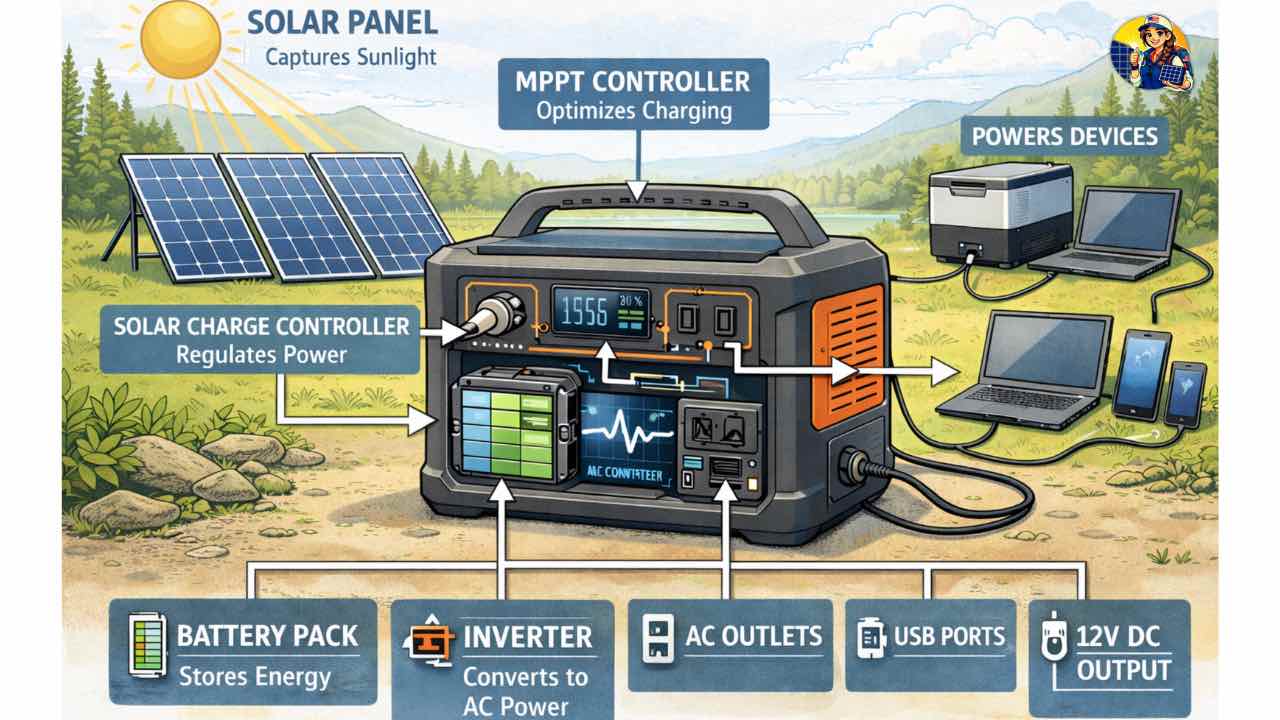
Welcome solar enthusiast, today we will see a detailed guide on solar generators. We will cover A to Z aspects of portable solar generators starting from how it works, its main components, how is electricity actually produced, concepts like Watt (W) and Watt-hour (Wh), types of batteries used, pros and cons, detailed uses and buyers guide.
When we decide to produce power at home via portable solar generator, it’s important to know how electricity is actually produced and basic functioning of these generators. This will help you to select best solar generator in market based on your custom requirements. At end of this article you will know exactly how many devices will your solar powered generator charge in case of emergency or power cut or during outdoor camping.
Basic knowledge of solar generators helps you to chose the right model for your power needs
What is portable solar generator?
In layman terms:
- Portable: You can carry it anywhere (example: outdoor camping/emergency)
- Solar: Solar energy is used to generate electricity
- Generator: mechanism to generate power and store in battery for further use
It is a device which captures solar energy and converts it into electricity for daily use. This stored electricity is used to charge devices anywhere without any fuel or noise. You can carry this device for your outdoor camping (portable) or use this as an efficient power source during power outage, emergency or RV.
These solar powered generators are used to charge all devices which you can think of. For example:
| Device | Power Capacity |
| Smartphone (iPhone + android) | 10-20W |
| Ipad | 20-30W |
| Smart watch | 5W |
| Macbook | 45-100W |
| Desktop computer | 200-400W |
| LED TV | 60-150W |
| Game console (Xbox Series X) | 180-220W |
| Printer | 300-400W |
| Mini refrigerator | 100-250 W |
| Camping lights | 5-20W |
| Portable Fan | 20-50W |
| Coffee maker | 600-1200W |
| Blender | 300-600W |
| Full size refrigerator | 400-800W |
Any decent solar generator is capable of charging above devices based on its battery and output capacity. So, you can truly understand the importance of this portable solar generator in case of emergency and power outage.
On an average, this solar generator fully charges in 5-6 hours during daytime. And this stored energy can be used throughout the day for all household needs as well.
You just need to decide which devices to use at a time based on:
- Requirement (priority)
- Battery capacity
- Availability of usable power in battery
How does solar generators work?
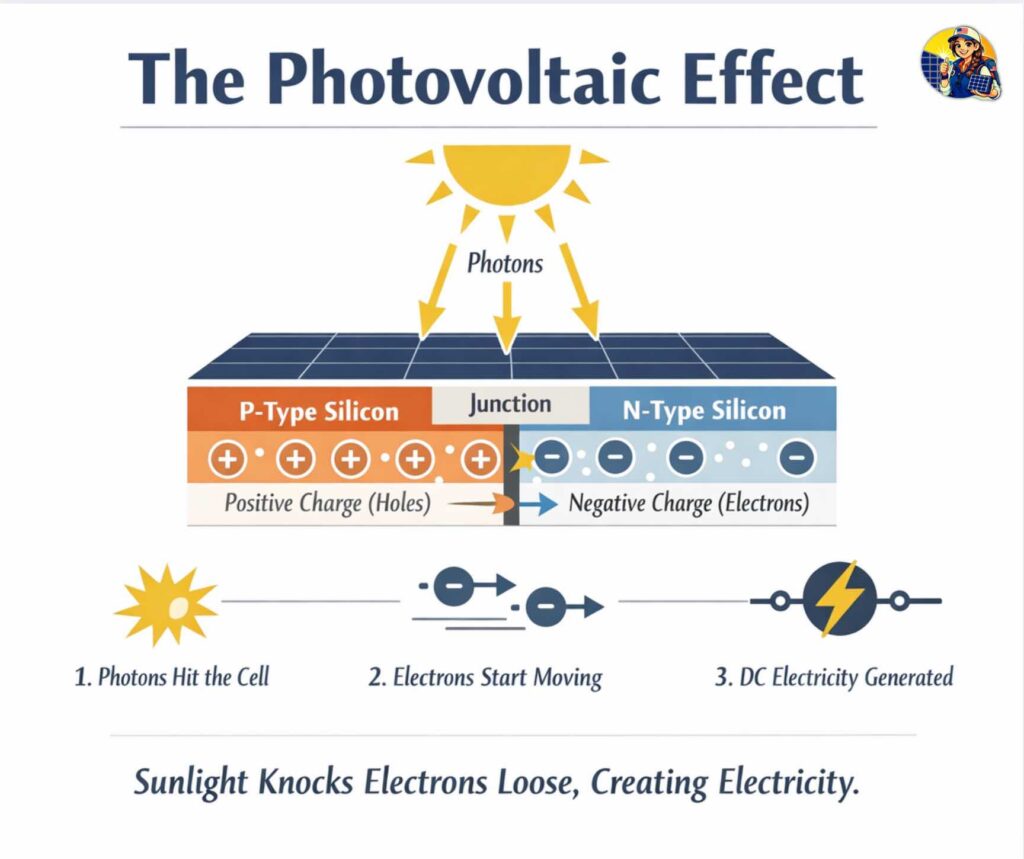
Solar generator consists of solar panels which works on basic principle of ‘Photovoltaic Effect‘
Solar panels are made up of silicon cells. Within each silicon cell:
- P-Type silicon: has positive charge (holes)
- N-Type silicon: has negative charge (electrons)
When solar rays fall on the solar cell, photons knock electrons loose. This results in the movement of electrons. This movement of electrons create DC electricity.
A) Step 1: Solar rays will hit solar panel during day time (5-6 hours during day time)
B) Step 2: The solar panel will produce DC power (Direct Current)
C) Step 3: Inverter converts this DC into AC (Alternating Current) because majority of household devices can consume only AC power.
D) Step 4: If any additional energy is produced, it is stored in the battery. So, this stored energy can be consumed later at night or power outage or any emergency.
10 main components of solar generator (Actual Functioning)
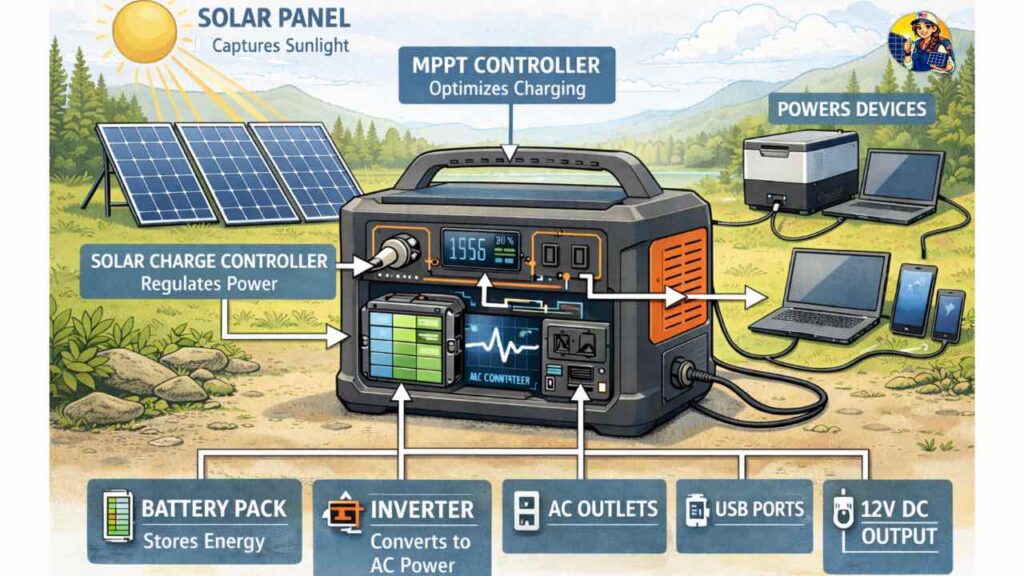
Components of solar powered solar generators are as follows:
- Solar Panels
- Charge Controller (MPPT/PWM)
- Battery (Energy Storage)
- Inverter
- Battery Management System (BMS)
- Input ports (Charging ports)
- Output ports
- Cooling system
- Casing and handle
- Display screen
Let us see function of each in detail with practical example:
Solar Panels
Solar panel is the most important part of solar generator which determines how much energy will be created by generator. Its capacity is measured in watts (W). Larger capacity of solar panel will produce more power, so choose solar panel capacity accordingly.
Higher watt panels play a very crucial role especially when sunlight hours are less. Because it can capture large amount of sunlight in less time for energy creation. So, selecting solar panel is crucial based on your use case
| Use case | Solar panel specification |
| 1. For outdoor camping or travel | Portable foldable panels preferred. Capacity around 100W to 200w |
| 2. For complete home backup | High-watt fixed panels, multiple panels |
| 3. In area where sunlight present for 2-3 hours only | High-watt fixed panels, with accurate angle of tilt |
| 4. For small devices (Mobile, iPad, laptop) | Solar panel with around 100W capacity |
Use case: A 200W solar panel can recharge a 1000KWh portable solar generator in 5-7 hours of good sunlight.
Parameters like angle of tilt of panel, cleanliness and temperature of panels, quality of sunlight, etc play a crucial role in amount of energy produced from generator
Charge Controller (MPPT/PWM)
Generally charge controller used in generator is neglected by many buyers. Charge controllers play a crucial role in maintaining safety and increasing efficiency of solar generators. It protects the battery of generator from overcharging, overheating and any power fluctuation.
We recommend to buy solar generators with MPPT controllers which are more efficient than PWM. These controllers also help to increase solar output in cloudy and less sunlight regions.
Charging speed of battery from 0-100% depends on quality of controller used.
Battery of electric solar generator is costly part. So, protecting it from damage and increasing its efficiency is must
Battery (Energy Storage)
Battery capacity is measured in watt-hours (Wh) or kilowatt-hours (kWh)
Whatever electricity is produced by your solar powered generators will be ultimately stored in your battery. So, based upon your energy requirement and use case, battery capacity will vary.
If you have invested in good capacity of battery, it will charge more devices and for longer duration in case of emergency or when sunlight is not available. If you want to charge multiple devices simultaneously and for longer time, go for large battery capacity.
Example:
Battery capacity: 1000Wh
This battery can run a 100W LED TV for 10 hours when fully charged or it can charge 50 W MacBook Pro 20 times or it can run 200W mini-refrigerator for 5 hours
So, select proper battery capacity based on devices requirement.
Inverter
Energy generated from solar panels is stored in battery as DC power.
But most of the home appliances like TV, refrigerator, desktop computer, oven, etc need AC power (Alternating current) to run efficiently. So, here comes the role of inverters. Inverter converts stored DC power into AC power used by home appliances.
Inverter capacity is measures in watts (W). This determines how many appliances you can run at one time. It is generally seen that some appliances require higher surge power during startup. So, always choose an inverter with extra headroom than your device.
Inverter capacity: It tells how much total AC power inverter can supply at a time. So, if your solar power consumption need is 800W, then inverter capacity of 1000W is a safe choice.
Example:
1. If you want to start a home appliance of capacity 800W, inverter capacity around 1000W is considered safe margin. And if you want to start multiple applications at a time, inverter capacity will increase accordingly.
2. A 1500W inverter can run small kitchen appliances, TV’s, fans, laptops and mobile phone at a time.
Inverter Size >= Total Running Watts + Highest Surge Watts
We recommend to go for pure sine wave inverters due to its safety.
Battery Management System (BMS)
Battery management system brings additional layer of security to our solar generators by monitoring:
- Temperature
- Voltage
- Current
- Charge cycles
If any of the parameter is out of range, BMS automatically shuts down the power of battery and gives alarm on display. This protects the battery from damage and unsafe working conditions. Good BMS increases the battery lifespan and also is critical for long term reliability.
In all the gadgets where large capacity batteries are used, safety pay becomes a major concern. so, BMS plays a very crucial role to monitor these critical parameters.
This is completely automated process. So, user do not have to look into these technicalities.
Input ports (Charging ports)
It is obvious that input to a portable solar power generator will be solar energy via solar panels. But these solar generators offer an additional way to charge the generators in case of emergency.
- Charge via solar energy (main input)
- Charge via AC ports (AC wall outlet) in case of emergency
- Car charging
Scenario:
Suppose you have planned for outdoor camping, and your solar generator is not fully charged. Now you do not have 5-6 hours to charge your solar generator or there is no sufficient sunlight for charging the generator. What can you do in this case?
In such cases you will charge your solar generators on AC ports of your house for fast charging. It generally takes 45-50 minutes to charge battery from 0 to 80% via AC port (Example: Jackery portable solar generator)
This is excellent feature offered by latest solar generators which is highly helpful in case of emergency, camping, RV, etc. You can simply charge your generator, and carry this electric solar generator as a portable power source.
Output ports
Energy produced via solar generators is stored in the battery (kWh). But how can we use this stored battery power?
There are 2 types of devices:
- AC powered devices: All home appliances which need comparatively more power
- DC powered devices: Smart phones, tablets, laptops, power banks
Portable solar generators can power AC as well as DC powered devices. It has multiple output ports for charging purpose:
- AC outlets
- USB-A
- USB-C
- 12V DC ports
In case of few solar generators, we can see multiple ports of each output which offers charging different devices simultaneously.
Each output port has its own importance. USB-C type is preferred for fast phone and laptop charing. AC ports are used for household appliances. So, select solar generators based on your use case, it matters the most!
Cooling system
In case of devices where high power capacity batteries are in action, maintaining optimum temperature is important. so, cooling system is must for protection of all internal components.
Fan and heat sink activate automatically when power usage increases. Battery Management System (BMS) and cooling system work hand in hand to keep the overall temperature under working conditions.
Overheating can reduce the efficiency and lifespan of battery drastically. Moreover, when generators will operate at maximum capacity, chances of temperature rise are high. So, these small but crucial features are must for heat control.
Use case: Solar generator may give AC output to power a microwave. So, running a microwave without overheating the generator becomes important task.
Casing and handle
Casing protects the solar generator from any kind of physical damage. Many people use solar powered generators for outdoor camping, for emergency situations, etc. So having a robust and strong casing is very crucial.
Generally these casing are also made from rust free, dent free and fire resistant materials. It can also withstand high temperature exposure and harsh environments. This is best suited for outdoor use age.
Handle and wheels offer a good degree of freedom to solar generators which truly make them portable. You might have seen people carrying the solar generators with ease for camping and other outdoor requirements.
Display screen
Display screen helps to monitor usage in real time. It displays various parameters of solar generators like:
- Battery percentage
- Input & output power matrix
- Warnings and charging status
- Overheating and overcharge signals
- Other control features
- Battery health
- Total unused power capacity
This increases the overall user experience and helps us to monitor health of battery and other internal components of generators. No major issue will arise in your solar powered generator if you are vigilant and see warnings on display and tackle them there itself.
Use case: Display gives us a basic idea about how many more devices can be charged from generator and when to connect the input power.
Type of solar generators in US market
There are many types of solar generators used in US. It depends on specific conditions like how many appliances you need to power on solar energy, space considerations, portable or stationary, etc
Most popular among all the generators are portable solar generators because of its ease of use, outdoor charging capability, portability, multiple charging options in case of emergency, no space blocking, and utility.
| Type of generator | Specific use case |
| 1. Portable solar generators (60-70% market share) | Camping, RV, off grid weekend use, emergency situation, power outage |
| 2. Home solar generators | Backup for complete home appliances in case of power outage |
| 3. Hybrid solar generators | Can switch between solar, grid and gas (Solar + AC grid) |
| 4. Portable power stations | Stationary stations with large production capacity |
| 5. Expandable modular solar generators | Customisable for increasing power needs |
| 6. Solar + battery backup systems | Combination home systems |
| 7. Specialised home generators | To power a specific device category on solar (example: refrigerator, outdoor lights, etc) |
So, select best solar generator model for your house based on your custom requirement.
North America dominates the solar generator market, making up over 35% of global share
Solar generator vs Gas generator: Key differences
- Solar generators: Solar powered generators, quiet and ideal for indoor backup and emergency situations
- Gas generators: Fossil fuel powered, they deliver higher power but require fuel, high maintenance and outdoor loudy operations
Gas generators dominated the energy production market, but now most of them have shifted to portable solar generators and solar power stations due to its benefits and renewable energy source.
We will see a comparison table of solar generator vs gas generator for complete understanding:
| Solar Generator | Gas Generator |
| Uses solar energy for power generation (solar panels) | Uses energy generated from gasoline/propane combustion for power generation |
| Free (sunlight) | Fuel expense and high maintenance |
| Silent operation | Loud operation |
| Zero emissions | Emits fumes, pollution |
| Safe for indoor use | Not safe |
| Low maintenance | High maintenance |
| Directly plug and play | Fuel handling requirement |
| Instant start stop feature | Manual start |
| Power is limited to battery capacity | Unlimited power capacity as fuel can be easily refuelled |
| Can be used for outdoor camping, RV, emergency situations | Preferred when high power needed for long time |
| Environment friendly | Not environment friendly |
Hopefully the picture is now clear regarding gas generator vs solar generator. If you are currently using gas generator, its high time to switch to portable solar powered generators considering environmental concerns.
Solar generator vs Power Station: Are they same?
Generally people think solar generators and power stations are one and the same. But they are not same. There is a sharp difference between their use case.
Solar generator: It is positioned as a backup power solution. It is more like energy production alternative to gas generators.
Solar power stations: It is positioned mainly as portable energy storage system. Portability is major differentiator here. Its main differentiator is large battery bank with AC power which can be carried for outdoor camping, emergency situations.
| Solar generator | Solar Power Station |
| Emergency and backup power | Portable clean power |
| Outage preparedness | Convenience and travel |
| To power all home appliances | Camping, RV, devices |
| Medium to very large | Small to large |
| Backup, emergency generators | Portable, fast charge |
| Prefered by homeowners, families | Prefered by campers, travellers, emergency outage backup |
| Longer runtimes | Portability focused |
Technology wise solar generators and power stations are same. Difference is only in the use case of both
Understanding output power (Watts, AC, DC, Surge Power)
Watt (W): Speed of electricity production or usage
Watt-hours (Wh): Amount of electricity produced/stored per hour
O- Output (W): Total watts supported as output from solar generator
Direct current (DC): Electricity flows in one direction. Solar panels and batteries produce DC Power
Alternating current(AC): Electricity that changes direction. AC is used by home appliances in USA
Surge power: Short burst of extra power when a device starts
Decibel (dB): Unit to measure sound produced by solar generator
Solar panel capacity is explained in watt (W). Solar panel captures solar light in watt and is then stored in battery as DC power. Battery capacity is explained in Wh, means how many Watts can it supply per hour.
Example: A 200 W Solar panel can charge a battery of 1000Wh in 5-6 hours if proper sunlight is available. 200 watts/hour for 5 hours=1000Wh (battery capacity)
Power produced by solar panels is stored in battery in DC power. But most of the home appliances need AC power to function. So, inverter converts this DC power into AC power for appliances to work.
If we want to power a refrigerator of capacity 1000W, we will need solar generator output W capacity to be more than 1000W. But most of the applications need surge power for 1-3 seconds after start. So, select generator which has sufficient output capacity to power all your devices safely.
Golden rule: Always choose a solar generator with surge power 2X of its continuous output.
Example: If your appliances output needs 800W of continuous power, select solar generators which can handle surge power of 1000W.
Can a solar generator power a Refrigerator or Air Conditioner?
Yes, ofcourse you can power mini refrigerator and even normal refrigerator on solar generator. For that you need to select generator with certain specifiations. Lets see based on practical scenarios:
Case 1: Refrigerator (Taking absolute value for calculation)
- Refrigerator running power: 200W
- Starting surge: 1000W (Short burst)
- Duty Cycle: 40% (Compressor works part time)
- Backup time expected: 8 hours
Since the fridge does not run continuously,
Effective power=200W x 0.4 =80W
Energy=80W x 8 hours=640Wh
Add losses (20%):
640 x 1.2=768Wh
So, to run a refrigerator with above conditions on solar generator, you will need:
| Component | Exact Value |
| Battery capacity | 800Wh (minimum) |
| Practical battery capacity | 1000wh |
| Inverter | 1000W |
| Surge capacity | >=1200W |
(So, a 1000Wh solar generator can run fridge with above configurations for 8-10 hours)
Case 2: Air conditioner (AC)
- AC Type= 1 ton inverter AC
- AC running power: 1000W (small window AC/Portable AC)
- Starting surge: 3000W (Short burst)
- Backup time expected: 6 hours
Energy consumption=1000W x 6 hours =6000Wh
Adding losses (20%):
6000 x 1.2=7200Wh
So, to power a air conditioner with above conditions on solar generator, you will need:
| Component | Exact Value |
| Battery capacity | 7200Wh (minimum) |
| Practical battery capacity | 8000Wh |
| Inverter | 3000W |
| Surge capacity | >=4000-5000W |
(So, a 8000Wh solar generator can run AC with above configurations for 5-6 hours)
There is no point of powering Air conditioner (AC) on solar generator. It will consume most of the battery capacity and will not allow other appliances to charge for long time.
So, use portable solar generator for emergency charging purpose, not for devices like Air conditioner.
Can a solar generator power an entire home?
Yes, a solar generator can power an entire home. We have seen solar generators being used for outdoor camping, emergency situations, power outages, etc. But it can also power entire home (multiple home appliances). Also when we want to power entire home, we can add multiple stationary solar panels of high absorption potential for capturing large solar energy per hour. Let us see a practical example of how to power entire home using solar generators.
We will consider below list of 10 appliances which are commonly used for household use. We will show practical plan where we can run all these appliances on solar power using portable solar generators.
Surge watts can be 2x-3x of running watts in case of heavy applications. So, we need to take care of surge watts too while selecting solar generator.
| Appliance | Running watts | Surge Watts |
| Refrigerator | 200W | 1000W |
| LED lights (10-12) | 120W | 120W |
| Wifi router + Modem | 30W | 30W |
| LED TV | 150W | 250W |
| Laptop / 2 Phones | 100W | 100W |
| Microwave | 1200W | 1800W |
| Washing Machine | 800W | 2000W |
| Gas Furnance Blower | 500W | 1200W |
| Window / Portable AC | 1000W | 3000W |
Total Running load: =4100W (200+120+30+150+100+1200+800+500+1000)
Worst case Surge load when all start together: 9500W (1000+120+30+250+100+1800+1200+3000)
Inverter must satisfy both the conditions:
- Running watt>=4100W
- Surge watt>=9500W
So, Inverter capacity required (Power output):
| Type | Value |
| Minimum | 5000W inverter |
| Recommended | 6000W inverter |
| Surge capacity | >=10,000W |
Battery Capacity (For 6 hours backup):
Energy required: 4100W x 6 hours=24,600Wh
Add losses (20%):
24,600Wh x 1.2=29520Wh
So, Battery capacity required (For 6 hours backup):
| Type | Value |
| Minimum | 25,000Wh (25kWh) |
| Recommended | 30,000Wh (30kWh) |
When we planning to power all house appliances on solar generator, we have previlege of space. We can install stationary big solar panels for capturing maixumum solar energy during peak 5-6 hours of sunlight. Also we can keep a dedicated space for large batteries.
With above generator specifications, you can power above appliances for 6-7 hours when batteries are fully charged.
Important:
If you manage below points smartly, you can drastically increase solar generator efficiency and overall runtime of appliances:
- Sunlight intensity
- Panel orientation and angle of tilt
- Reflection & angle of incidence
- Using applainces only in case of use (optimize use)
How many solar panels do you need for solar generator?
There is no one size fit for all. Number of solar panels needed for solar generator depends purely on your power requirement. We will see different use cases and requirment of sonal paels for each:
Assumptions:
5 peak sun hours/day
Angle of panel and panel temperature is maintained
Normal losses of generatore included
| Use case | Solar generator size | Recommended panels |
| Camping/ small devices | 1000Wh | 2-3 panels of 100W capacity |
| Fridge and lights | 2000Wh | 4-5 panels of 100W capacity |
| Home essentials | 3000Wh | 3-4 panels of 200W capacity |
| RV or Off grid use | 5000Wh | 3-4 panels of 400W capacity |
| Whole home essentials including AC and refrigerator | 9000Wh | 5-6 panels of 400W capacity/ 10-12 panels of 200W |
More wattage panles=fewer panels needed
400W panels are best for home backup
200W panels are best for portable use
Solar generator battery types Explained (Li-ion vs LiFePO4)
Battery is important component of generator. Because whatever solar power is generated will be ultimately stored in battery. So, battery configurations play a very crucial role in overall efficiency of solar generator. Portable solar generators come with multiple type of batteries:
- Lithium Iron Phosphate (LiFePo4/LFP) (Highly recommended by our team)
- Lithium-Ion (NMC/NCA)
- Lithium Polymer (Li-Po)
- Sealed Lead-Acid (AGM/Gel)
- Nickel based Batteries (NiMH/NiCd)
There maybe multiple options, but Lithium Iron Phosphate (LiFePo4) batteries are best for your solar generator. Lithium Iron Phosphate batteries use modern lithium battery technology designed for long life, safety and stability. It stored energy more reliably over many years of repeated charging and discharging.
Why choose Lithium Iron Phosphate (LiFePo4) batteries over other options?
- Exceptionally long cycle life
LiFePo4 batteries typically support 3000-6000 full charge cycles, farr better than lithium ion batteries. This battery can be used for years without major capacity loss.
- Higher thermal stability (safety measure)
LiFePo4 chemsitry is more stable at high temperatures, which significantly reduces the risk of thermal runaway, over heating or fire like situation. In case of outdoor and emergency use, this plays important role
- Good deep discharge capacity
In many batteries, cells are damaged during deep discharge. But LiFePo4 batteries are fedigned to handle this situation without cell damage.
- Consistent voltage output
- Higher charge/discharge efficiency
- Wide operating temperature range
- Works better on high power home appliances
- Low chances ofcapacity fade
- Better life span
There are few do’s and don’ts to increase the battery efficiency and increase its lifespan. Will cover that in separate article.
Solar generators for power outrage and emergencies
Solar generators are commonly used for home power backup, RV, camping and outdoor use. But power outage and emergencies is the strongest reason you should have a portable solar powered generator at your house.
Power outages are increasing every year in U.S. due to extreme weather events like hurricanes, winter storms, heatwaves and wildfires. Storm prone states like Texas, California, Lauisiana, New York experience the highest. So, get a decent generator to make your house power outage proof.
Suppose you want to run below home appliances in case of power outage:
| Appliance | Running watts | Surge power |
| Refrigerator | 200W | 1000W |
| LED lights (10-12) | 120W | 120W |
| Wifi router + Modem | 30W | 30W |
| LED TV | 150W | 250W |
| Laptop / 2 Phones | 100W | 100W |
| Microwave | 1200W | 1800W |
| Washing Machine | 800W | 2000W |
Total Running load: =2600W (200+120+30+150+100+1200+800)
Worst case Surge load when all start together: 5300W (1000+120+30+250+100+1800+2000)
Inverter requirement is to safely handle running load as well as surge load.
So, Inverter capacity required (Power output):
| Parameter | Value |
| Minimum | 3000W |
| Recommended | 3500W-4000W |
| Surge capacity | >=6000W |
Battery Capacity (For 6 hours backup):
Energy required: 2600W x 6 hours=15,600Wh
Add losses (20%):
15,600Wh x 1.2=18720Wh
So, Battery capacity required (For 6 hours backup):
| Type | Value |
| Minimum | 18,000Wh (18kWh) |
| Recommended | 20,000Wh (20kWh) |
In all above calculations, we have considered all appliances working simultaneously at same time (full load capacity). But in reality, we will use limited appliances. So, backup time of solar generator will be more than calculated above.
How loud is solar generator?
Gas generators are highly noisy as it consists of an engine for energy production. But in case of solar generator, there is no loud generator noise. We will see comparison of sound generated by generators in decibel (dB) for more clarity.
| Situation | Noise level |
| Solar generator (idle case) | 0 dB (Silent) |
| Solar generator (working) | 20-25 dB |
| Normal room conditions | around 30dB |
| Normal outdoor conditions | around 40dB |
| Gas generator | 95-100dB |
Electric solar generators are comparatively silent and produce almost negligible noise. it has no engine, no vibrations, no exhaust. Only noise you can notice is of internal cooling fan which is 25-30dB and considered very low.
How much time it takes to charge a solar generator?
Solar generator is primarily charged with solar energy. Time taken by solar generator to fully charge depends on solar panel capacity and battery capacity. Solar panels with larger capacity (400W+) can produce more electricity in less time of sunlight exposure. Let us understand this with example:
Note: We will consider constant solar energy for 5-6 hours per day and good angle of tilt
Charging Time (hours) = Battery Capacity (Wh) / Solar panel Power (W)
(Consider 10-20% losses in real life scenarios)
A) Case 1: If battery capacity is 1000Wh and solar panel capacity is 200W, it will take 5-6 hours for battery to fully charge
B) Case 2: If battery capacity is 1200Wh and solar panel capacity is 400W, it will take 4 to 5 hours to fully charge battery
C) Case 3: If 1000Wh battery is charged with AC socket, 0-80% charging is done in just 45 minutes. This extremely helps in emergency situations/ when you need quick charging
Parameters like quality of sunlight, angle of tilt, temperature of solar panel, cleanliness of panel affects the time of charging drastically.
How Many Devices Can a Solar Generator Run Simultaneously?
This is most common question related to solar powered generators. We will see based on practical example:
No of devices that can be charged simultaneously depends on 2 factors:
- Output power (Watt)
- Battery capacity (Watt-hour)
Rule: Total running watts of all devices <= Solar generators output watts
Example 1: Consider a solar generator with battery capacity 1000Wh and output 1500W, 200W solar panel capacity (Most common configuration of solar generator backup)
Suppose you are using below devices on solar generators:
| Device | Running Watts |
| Refrigerator | 150W |
| LED TV (55″) | 120W |
| Wifi router | 15W |
| Laptop | 66W |
| 4 LED Bulbs | 40W |
| 2 phone chargers | 20W |
Total running power: 150+120+15+66+40+20=410W which is still less than 1500W. So all these devices can work simultaneously.
How long will it run?
Total battery capacity=1000Wh
1000Wh/410W= 2.4 hours
So with solar generator of battery capacity 1000Wh and output 1500W, you can run refrigerator, led tv, wifi router, laptop, 4 LED Bulbs, 2 phone chargers simultaneously for 2.4 hours
Heavy home appliances like air conditioner, refrigerator, etc has a high surge power (2x-3x of running watts). So, these appliances must not be started simultaneously at same time. Otherwise very high inverter output capacity/surge capacity will be required.
Example 2: You are on outdoor camping with electric solar generator with battery capacity of 1000Wh and output 1500W. Solar panel to charge this generator is 200W (common configuration)
Suppose you want to use below devices on generator during camping:
| Device | Running watts |
| Portable camping fridge (12V) | 60W |
| LED string lights | 20W |
| Camping fan | 30W |
| Charging 2 phones | 20W |
| GoPro camera charging | 10W |
| Laptop | 65W |
Total running power: 60+20+30+20+10+65=205W which is still much less than 1500W. So all these devices can work simultaneously.
How long will it run?
Total battery capacity=1000Wh
1000Wh/205W= 4.8hours
So, if your battery is fully charged, you can use all above devices simultaneously during camping for 4.8 hours.
Above calculation of hours is based on consideration that you use all devices simultaneously.You can easily optimise by using only devices which are needed. This can easily increase efficiency by 25-30% keep all other conditions same.
Can solar generators work in rain and cloudy environment?
Yes, a solar generator can work even in rain and cloudy environment. Efficiency of solar power generation surely drops in rain, but still decent solar energy is still produced for household usage. Generally we associate solar power generation with solar heat. But only solar light is responsible for solar power generation. And in rainly season and cloudy environment, indirect and dispersed solar light is present which produces solar energy. Check this detailed article which explains how solar panels generate power even in rain, cloudy environment and cold seasons.
Solar generators do not work at night, as 0 light is present for power generation. But this does not mean that you cannot get solar power at night. During day time, solar panels capture sufficient amount of solar power, and this excess energy (in Wh) is stored in solar batteries. Most solar generators come with decent battery capacities (1000Wh+). This is sufficient to supply solar power when generation is less or 0.
Summary of power generation in different scenarios:
Normal sunny day: 98-99% output
Light Clouds: 60-80% of normal output (Indirect light still exists during rain)
Cold seasons: 90-95% of normal output (Sun light still exists)
Heavy rain: 15-30% of normal output (indirect dispersed light)
At night: 0% of normal output (No sun light)
If you still have any questions related to portable solar generators or power stations, fell free to ask in comment section below.
Our team members will answer all your questions in 24-48 hours.


Hi Mark, this was extremely detailed information on solar generators. All important things are explained in so simple and understandable manner.
Really a masterpiece who wants to undrstand imp concepts of solar generator and power stations!
Thanks Sam for your review. If you still have any issue or need help, do let us know
Thanks for reply, will contact you after shortlisting few generators.
Sure