
Hi solarites, welcome to our ‘Explained‘ section of bestsolargear.com
Today we will focus on a very common question that arrises in our mind regarding solar panels. Do solar panels work in rain? Do solar panels charge on cloudy and cold weather?
Introduction
These are actually genuine and logical questions. So, to directly answer your question, yes, solar panels do work in rain and cloudy environment. Also efficiency do not drop drastically. You will get decent power generation even in rainy season via solar panels and solar generators. But there are many things which impact the efficiency of solar panel in rain and cloudy season. In this detailed blog, we will start from very basics and cover this topic in detail so that all your questions related to solar power generation in rainy season are tackled.
If you have planned to install solar panels for energy generation, then this is must read article for you. As we have given ‘to do list’ to improve solar energy output in rainy and cold season considering the USA climatic conditions.
How solar panel works?
Lets begin with basics.
A solar power system has 4 main components:
- Solar panels – Capture incoming sunlight
- Inverter – Converts electricity into usable form (DC power to AC power)
- Electrical panel – Distributes power (AC power)
- Grid / Battery – Stores or exports extra power generated
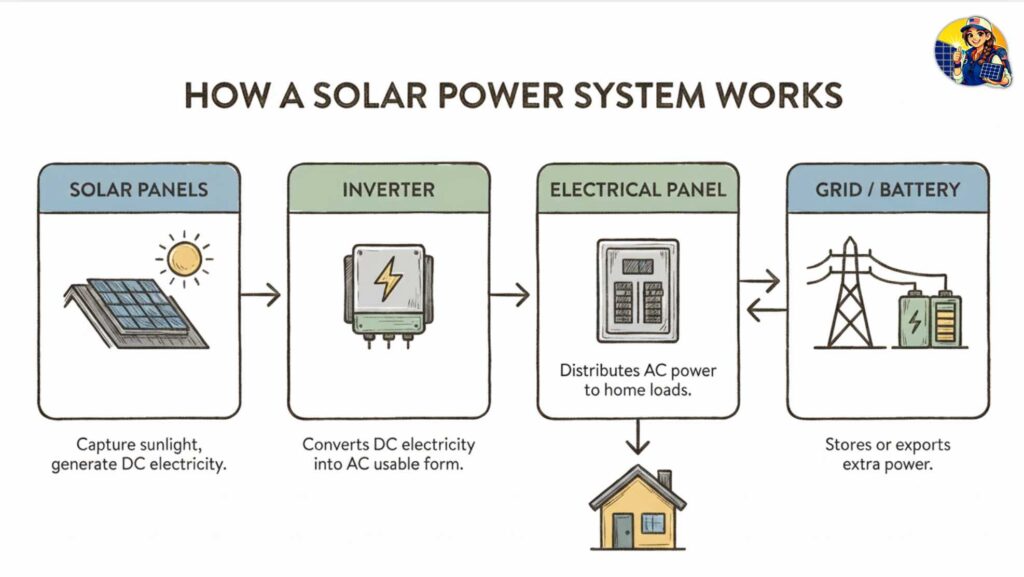
A) Step 1: Sunlight will hit solar panel during day time
B) Step 2: The solar panel will produce DC Electricity (Direct Current)
C) Step 3: Inverter converts this DC into AC (Alternating Current) because household can consume only AC power.
D) Step 4: Additional power left after household consumption, is stored in battery or passed on to power grid.
This is simple process followed to generate power via solar energy.
Photovoltaic Effect: The real energy generator
Within solar panels, phenomenon called as ‘Photovoltaic effect‘ is responsible for power production. We are discussing about Photovoltaic effect because whether it is sunny or cloudy day, a rainy or non rainy day, its a photovoltaic effect that decides whether energy is created or not.
This may sound so technical and boring to you, but this simple concept will clear all your questions regarding solar energy generation in rain.
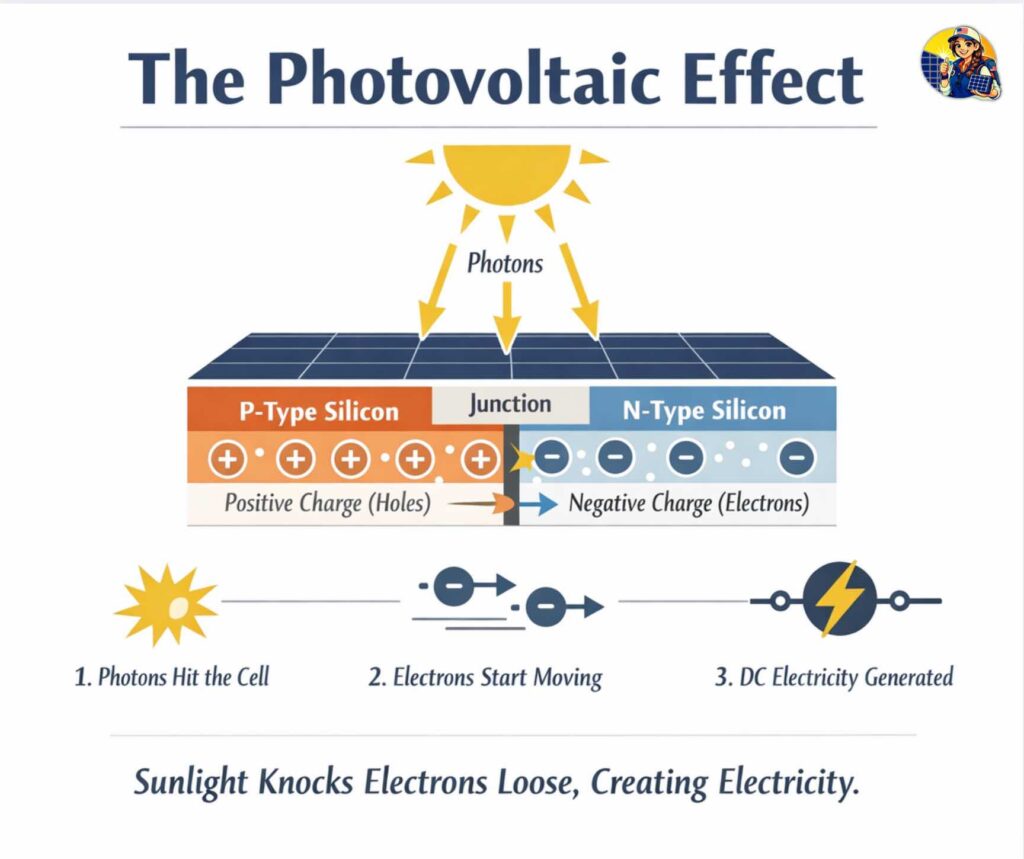
Solar panels are made up of multiple silicon cells.
Within each silicon cell:
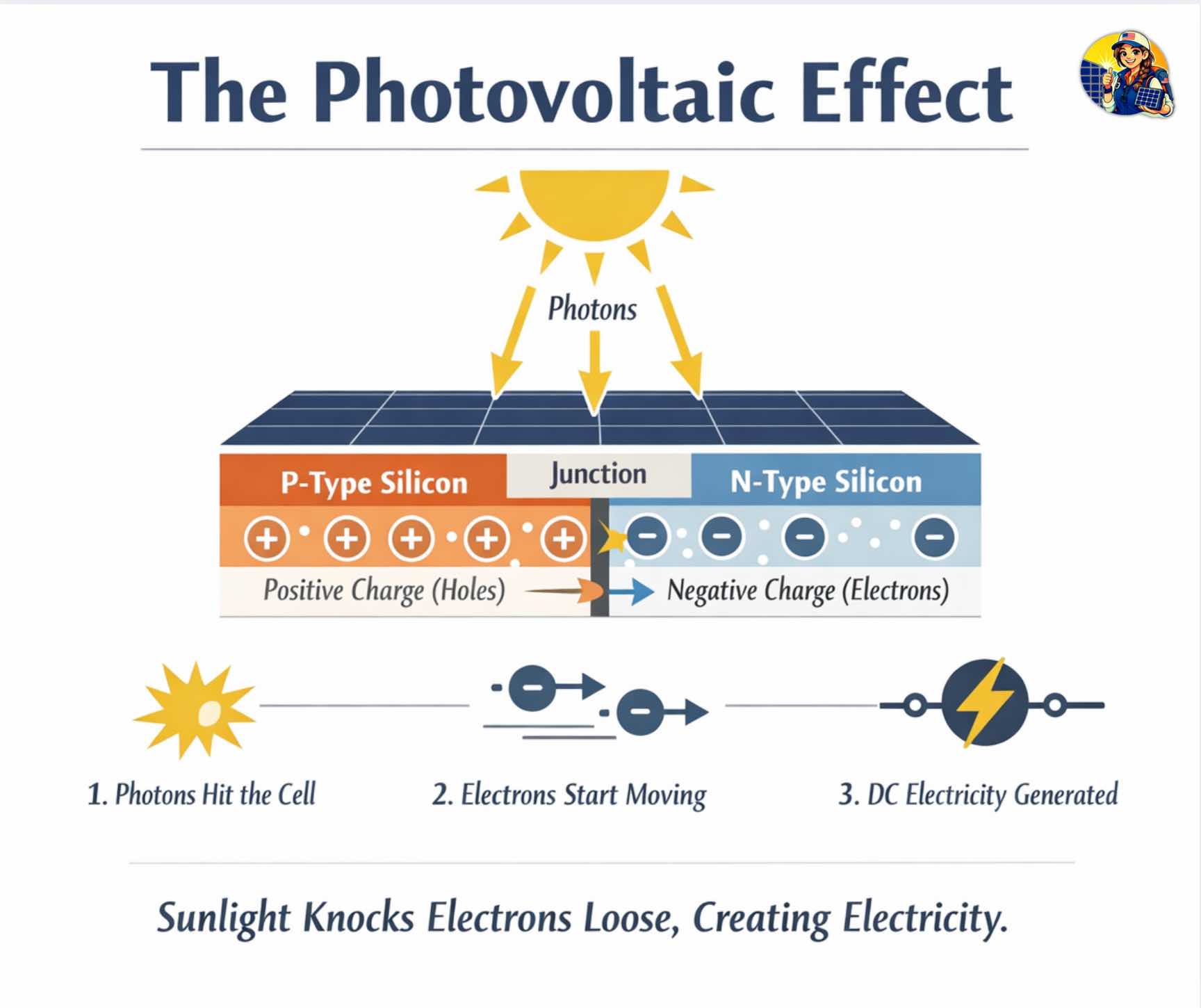
- P-Type silicon: has positive charge (called as holes)
- N-Type silicon: has negative charge (called electrons)
When sunlight falls on the solar cell, photons knock electrons loose and electrons start moving. This movement of electrons create DC electricity.
This process is called of photovoltaic effect. As simple as that!
Solar power generation during rain : Light vs Heat
Only Light is responsible for power generation, not heat. So, electricity is produced even in rain as light is still present (indirect light)
It is common misconception that heat is must for power generation. Whenever it is raining or cloudy environment or cold season, temperature is less and environment is comparatively cold, so we think that solar energy will not be produced. But even in case of rain/cloudy environment, indirect light falls on the solar panel during day. So, this activates the electrons and energy is generated.
Taking in terms of efficiency, solar panels efficiency is bit low in case of rain, but energy is still produced in decent amount.
Normal day: 100% output
Light Clouds: 60-80% of normal output (Indirect light still exists during rain)
Heavy rain: 15-30% of normal output
So, even in case of heavy rains, power generation will not be zero. It will be still between 15-30% of power output which you get on normal days. So, now its clear solar energy production is not proportional to heat, it is proportional to light.
In fact after rain, the efficiency of solar panels increases. Rain reduces heat, washes the dirt and bird droppings from the solar panel. These clean panels in fact absorb more sunlight which increases efficiency of solar panels. So, ideally it is recommended to keep the solar panels cool for higher power efficiency which is automatically done by nature during rain.
And no need to worry about solar panels during rain or storms. because:
- Solar panels are fully waterproof
- They are designed to withstand rain, huge storms and humidity
- Electrical parts of solar panels are sealed and grounded. So, no chance of shock.
Apart from rain, you must know few important parameters other than rain which impacts its efficiency drastically. Check this article for understanding in detail about solar generators, how they function, how to select best one for your use case.
Parameters that influence solar panel output (14 points)
Instead of focusing on solar panel efficiency in rain, you need to focus on few important parameters which play a very crucial role in deciding your solar panel efficiency. If you are sincere in installing solar panels based on below parameters, you do not need to worry about rain or any other parameter impacting solar production.
List of parameters which directly impact your solar energy production:
- Sunlight intensity (imp)
- Panel orientation and angle of tilt (imp)
- Reflection & angle of incidence (imp)
- Solar panel technology
- Temperature (solar panels must be cool)
- Inverter efficiency
- Airflow & ventilation
- Shading
- Panel cleanliness
- Installation quality
- Panel age & degradation
- Wiring & electrical losses
- Geographic location
- Panel size / surface area
Crucial solar panel installation tips
- Solar intensity or solar irradiance is measured in unit W/m2. This is important parameter which decides how much power will your panels generate
- Premium solar panels are 3-4 percent more efficient than typical residential panels. So, more output in same space
- Around 0.35% to 0.45% energy output is lost per 1 degree Decius temperature rise of panel. So, its must to keep panels cool
- Shading from trees or any object will directly impact output
- Solar panels have a lifespan of 25-30 years. Higher quality degrades slower and can produce at 85-90% of capacity even after 25 years
- Inverter must be efficient to reduce inverter losses down to 1-2% (DC to AC conversion loss)
- Monocrystalline cell technology is more efficient. You can even go for bifacial panels which absorb light from both sides
- PERC/HJT/TopCon cells are optimised well even for low light.
- Solar panels auto adjusting technology with sun direction helps to increase output.
- Keeping solar panels clean and cool are most neglected. So, maintain a system to do it on frequent basis
- Energy saved is equal to energy generated. So, reducing energy losses is crucial part of solar energy model.
You can drastically increase per square meter efficiency by considering above points while solar installation
So, whenever you are installing solar panels at your home, make sure that above parameters are considered by your installer. Because we have seen many examples in our last 10 years of experience where 2 solar panels installed in same locality of United States producing different outputs, only because of small but critical mistakes during installation and poor solar panel selection.
Selection parameters of solar Panel
Selection parameters of solar panel or solar device is dependent on your need and use case.
You can make solar energy primary source of energy production (100% migration to solar), or you can start with partial solar energy production. Currently in market we have solar generator and portable power stations, solar batteries, solar power banks, etc of various power generation capabilities. You can select the best based on your requirement.
If you are confused in selecting a good solar product for your use case, you can check detailed blogs on our website for detailed review and user guides. Selecting a solar panel for your solar energy needs scientific calculation. We have covered it in different blog.
Solar panel efficiency: Day vs Night
The solar panels do not produce electricity at night (0% output)
Solar panels can produce sunlight only during day time (bright sunlight, during rain, cloudy weather or cold seasons). But at night, there is neither direct light nor indirect light rays. Also there are no chances of dispersed light. So, power solar production is 0 at night.
Note: No solar power generation at night does not mean that you cannot get any power to use at night. Because sufficient amount of solar power is stored during day time in solar batteries (in Wh). This stored energy can be used at night or when power generation is low.
Summary (To the point)
- Solar panels generate power even during rain, cloudy weather or cold seasons (efficiency may vary, but still decent output is achieved)
- Focus on other important parameters as well like solar intensity, angle of tilt, angle of incidence, etc which are more crucial factors than rain or cloud.
- Most solar generators and solar power stations come with good battery capacity (1000Wh+). So, solar energy produced by solar panels during day time is stored in this battery. This energy is used at night or when there is low solar energy production. So, you need not worry about household power consumption.
Normal sunny day: 98-99% output
Light Clouds: 60-80% of normal output (Indirect light still exists during rain)
Cold seasons: 90-95% of normal output (Sun light still exists)
Heavy rain: 15-30% of normal output (indirect dispersed light)
At night: 0% of normal output (No sun light)
Hopefully your question ‘Do solar panels work in rain?’ is cleared. If you still have questions related to it, feel free to comment below. All your doubts will be answered by our team within 24-48 hours.
Frequently asked questions (FAQ’s)
Yes, it can. Because indirect and dispersed light is present even during rain. Efficiency is less than normal day, but still decent solar power can be obtained
No. Not possible. Because light is absent at night
If you have excess energy left after domestic consumption, you can store in batteries. Other option is to supply this energy to power grids.
We are currently testing different vendors and visiting different solar power generation sites. Soon we will make a detailed guide on best vendors in US market.